

Composed PDFs#
Composed PDFs build on top of others and provide sums, products and more. These PDFs allow for creating complex models by combining simpler components.
Below are the available composed PDFs with descriptions of their functionality:
Sum PDF#
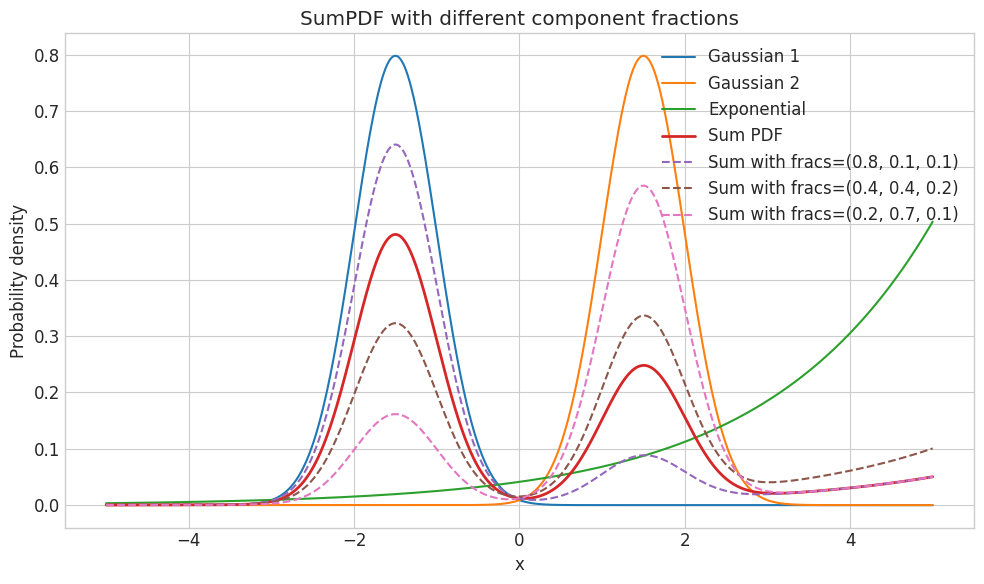
The SumPDF allows combining multiple PDFs with different fractions.
This is useful for creating mixture models, such as signal plus background.
|
Create the sum of the |
Product PDF#
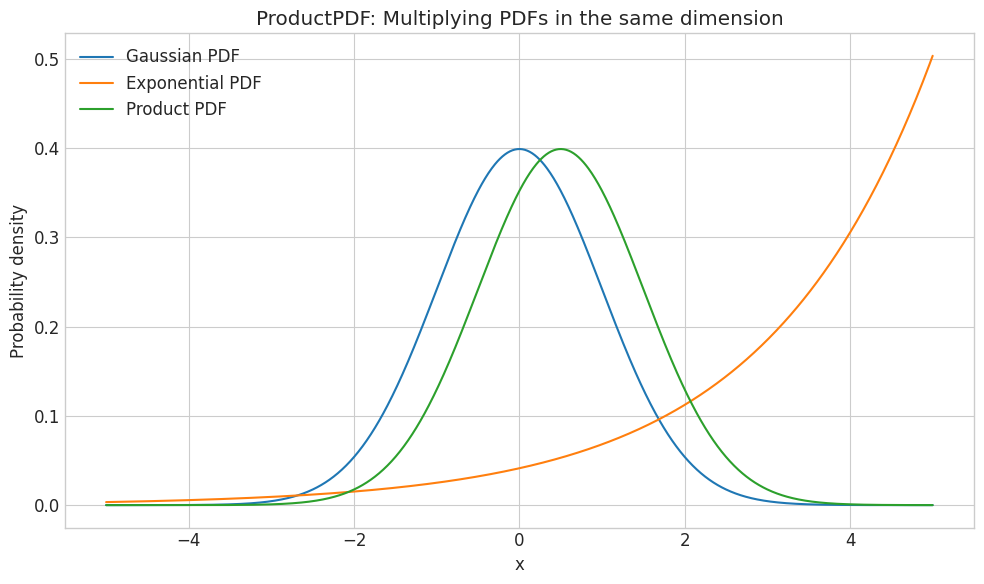
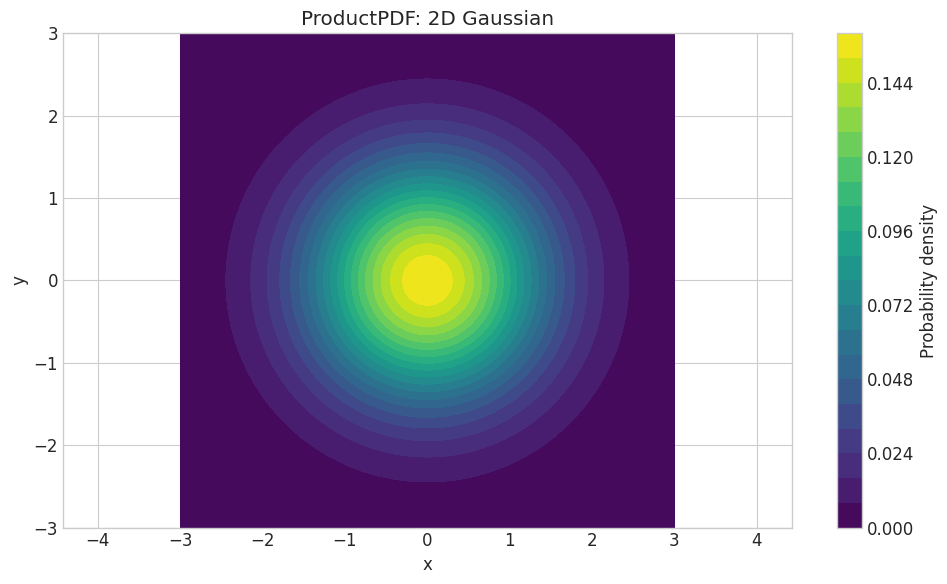
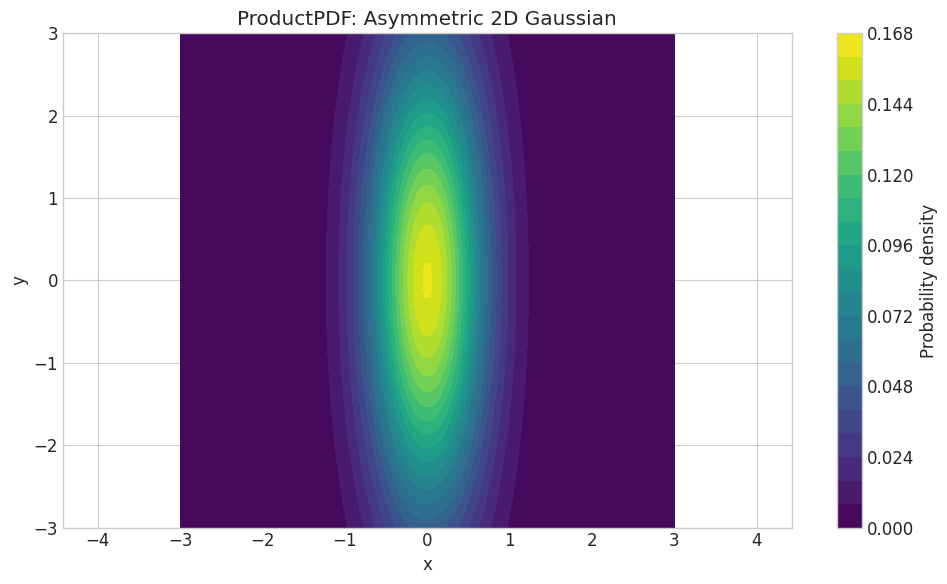
The ProductPDF multiplies PDFs together, useful for creating joint distributions or in the same dimension.
This is commonly used when variables are independent or when creating multi-dimensional models.
|
Product of multiple PDFs in the same or different variables. |
FFT Convolution PDF#
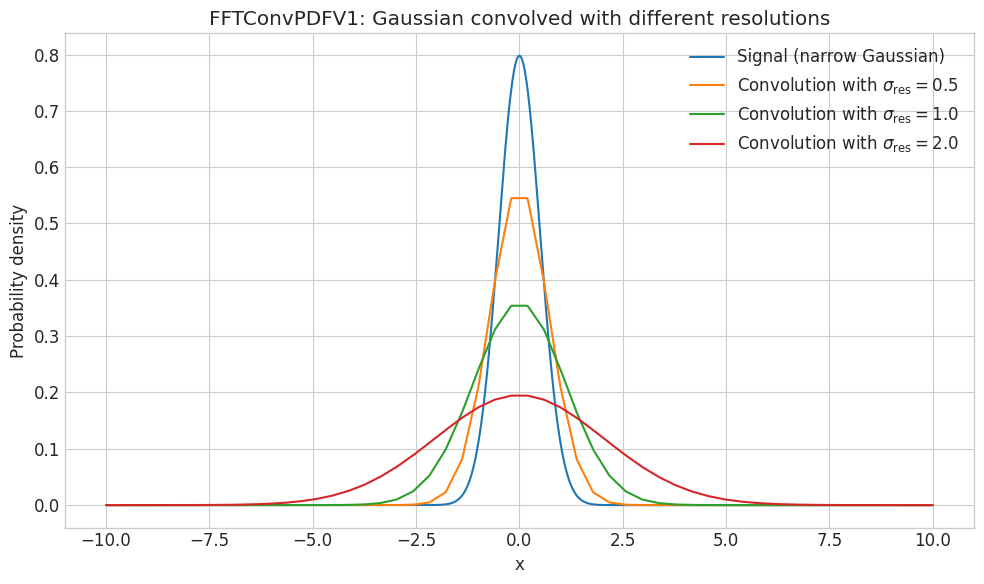
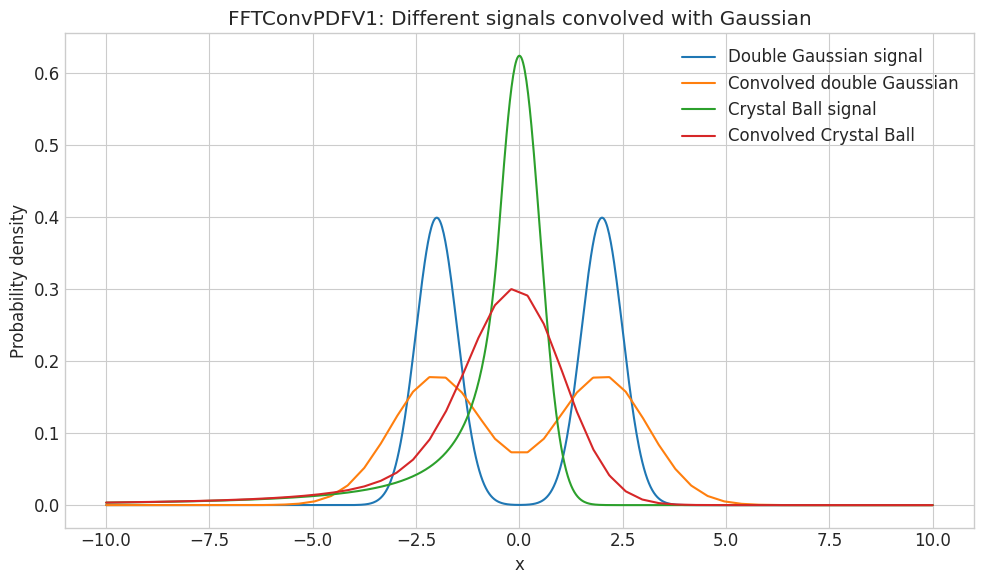
The FFTConvPDFV1 performs convolution of PDFs using Fast Fourier Transform.
This is useful for modeling detector resolution effects or other convolution operations.
|
EXPERIMENTAL Numerical Convolution pdf of |
Conditional PDF#
The ConditionalPDFV1 creates conditional probability distributions.
This allows for modeling dependencies between variables.
|
EXPERIMENTAL! Implementation of a Conditional PDF, rather slow and for research purpose. |
Truncated PDF#
The TruncatedPDF restricts a PDF to a specific range.
This is useful when you need to limit the domain of a PDF without changing its shape within that domain.
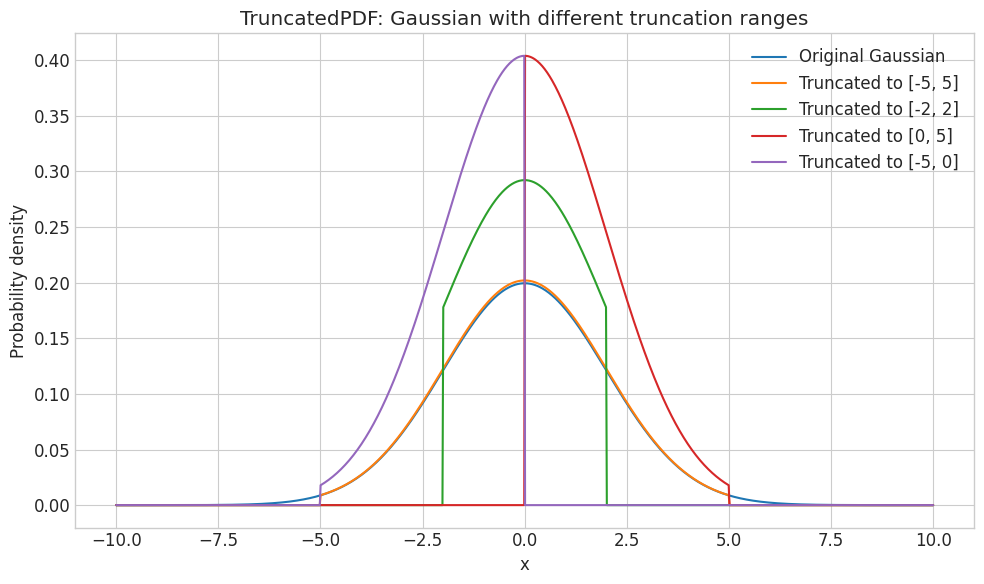
![TruncatedPDF: Different PDFs truncated to [-2, 2]](../../_images/truncatedpdf_various.png)
|
Truncated PDF in one or multiple ranges. |
Positive PDF#
The PositivePDF ensures the output of a PDF is always positive by clipping values below a minimum epsilon.
This is useful for PDFs that can produce negative values (e.g., KDE with negative weights) or numerical instabilities.
|
A functor that ensures the output of a PDF is always positive by clipping values below epsilon. |
All Composed PDFs
|
Product of multiple PDFs in the same or different variables. |
|
Create the sum of the |
|
EXPERIMENTAL Numerical Convolution pdf of |
|
EXPERIMENTAL! Implementation of a Conditional PDF, rather slow and for research purpose. |
|
Truncated PDF in one or multiple ranges. |
|
A functor that ensures the output of a PDF is always positive by clipping values below epsilon. |